On 5th of March The Cambridge Companion to Electronic Dance Music was finally published.
It was edited by Hillegonda Rietveld – Professor Emerita at London South Bank University. She has published extensively on electronic dance music cultures, and Toby Young – Professor of Composition at Guildhall School of Music and Drama, and Research Lead in Digital Performance.
Beate Peter, Catharine Rossi, Caspar Melville, Kai Fikentscher, Bianca Ludewig, Stefanie Alisch, Matthew Ming-Tak Chew, Tobias C. van Veen, Bernardo Attias, Chris Christodoulou, Rupert Till, Botond Vitos, Maria Perevedentseva, Nicolas Bougaïeff, Robert Fink, Tami Gadir, Samantha Parsley, Edward Katrak Spencer, Alice O’Grady, Alinka Greasely.
On 11th of May there will be a hybrid launch event, held in London at Guildhall and online, 5-6pm (BST).
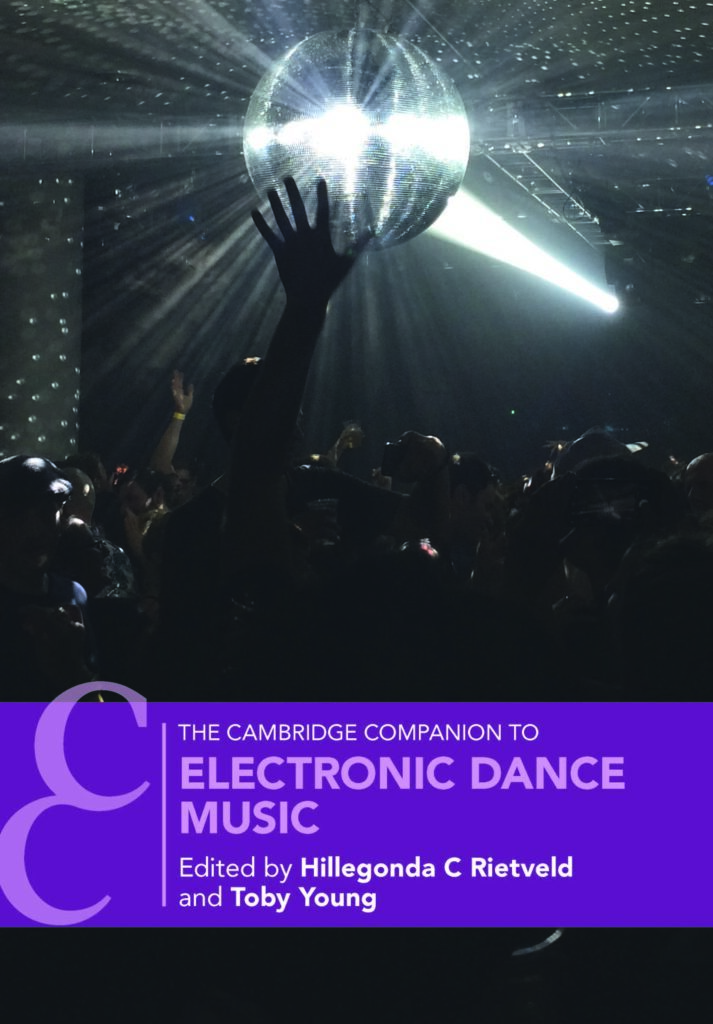 And here is the publishers blurb:
“Electronic dance music is increasingly the focus of a multitude of academic research projects around the world but has been drastically under-represented in accessible core published material. This innovative scholarly collection provides an important ‘first stop’ for researchers and students wishing to work in this area. It examines the key features of numerous electronic dance music scenes and (sub)genres alongside discussions of the musical, social and aesthetic experiences of participants to consider how these musical practices create purpose and cultural significance for millions around the world. At the same time, it introduces diverse theoretical approaches to the understanding of electronic dance music cultures and addresses the issues and debates in electronic dance music culture studies. Adopting an interdisciplinary approach drawn from both music and cultural studies – including music aesthetics, technologies, venues, and performativity – from a broad geographical perspective, the volume sheds fresh light on electronic dance music cultures.”
– Provides a thorough overview of the rich variety of cultural, social, spatial and technological contexts of electronic dance music
– Considers how the musical, cultural and spatial practices of EDM create purpose and cultural significance for millions around the world
– The first scholarly collection to offer an introduction to diverse approaches in the understanding of electronic dance music cultures
Close to 2010, there was an American music industry effort to reimagine rave cultures for marketing purposes. The aim was to remove negative connotations generated during earlier moral panics around the intensity of rave dance parties that solidly focussed on electronic dance music. They used the abbreviation e.d.m. to promote dance festivals with a pop-flavoured form of electronic dance music, which has since become known as ‘edm’. As this subgenre became popular amongst American teenagers, some confusion emerged with those for whom electronic dance music had long been understood as an umbrella term. The dual meaning of edm is where Toby Young and I, as editors, found ourselves when we started to compile our Cambridge Companion to Electronic Dance Music. Our decision was to offer a broad set of perspectives that cross disciplines and geographical places, with the understanding that there is no stable point of origin, nor a single cultural meaning to electronic dance music. We thereby wanted to avoid encyclopaedic narratives that repeat the marketing myths of individual careers. Instead, our Cambridge Companion offers a broad scope on the subject, from raves, sound systems and club design to issues in production techniques and DJing. In doing so, the collection presents a spread of local positions, not only from the US, UK, and Germany (as per usual) but also from countries like Italy, China, and Angola, as well as approaches that address identity politics in the studio and on the dancefloor. In all, an enticing compilation for you to want to find out more.”